01Direction
Direction
I turn broad opportunities into priorities, useful scope, success criteria and a next move the team can act on.
AI Adoption Specialist · E2M Solutions
I help agencies and companies turn AI tools into systems their teams actually use—by connecting the workflow, technology and people around the work.
Ahmedabad, India · Working with teams across the US, UK, UAE and beyond
I connect the business problem, the build and the people around it.
My edge is translating between clients, business problems, internal delivery teams and engineers.
I have spent more than five years building production AI and automation across agencies, fintech and operations-heavy businesses. Today, my job is wider: choose the right problem, shape the workflow, guide the build and make adoption real.
The fuller story behind the roleMy responsibility is not only to shape what gets built. It is to create clarity, develop ownership, maintain the delivery standard and help useful change stick.
I turn broad opportunities into priorities, useful scope, success criteria and a next move the team can act on.
I hire, mentor and give people the context they need to grow into confident, independent owners.
I make risks visible, remove blockers and keep quality, security and production readiness part of the conversation.
I connect the system with ownership, operating practices, training and feedback so the change becomes daily work.
I see the award as a standard to keep earning through stronger decisions, better support for the team and work that creates lasting value.
Build
I learned to turn business problems into working automation systems—and to stay accountable for what happened after delivery.
Ship
I built production document-processing, consolidation and transaction systems where accuracy, exceptions and reliability mattered.
Explain
I train Income Tax officers and visiting government officials on AI in investigation. It taught me that clarity is a technical skill.
Adopt
I connect client needs, delivery teams and engineers so AI becomes part of the work—not another subscription beside it.
I work across discovery, workflow design, rapid prototyping, production thinking and team enablement.
I map the work as it actually happens: repeated effort, slow handoffs, scattered knowledge and decisions that depend on one person.
A focused problem worth solvingI define the trigger, inputs, judgement points, ownership, review path and outcome before choosing the technology.
A workflow people recognizeI prototype early, guide the build and expose the boring production realities—permissions, cost, security, exceptions and maintenance.
A useful version teams can testI connect the system to SOPs, training, shared context, clear ownership and feedback so usage can become a habit.
Adoption that survives day 30The useful truth usually appears after the impressive part—when cost, context, permissions, habits and ownership enter the room.
Access was not the problem. The reset was shared Claude Projects, client context, SOPs, reusable Skills, one adoption owner and a weekly review.
Same subscription. A different operating system.Instead of adding another dashboard, the team could query Drive knowledge, reuse SOPs and generate stronger drafts through MCP-based retrieval inside Claude.
The best interface can be the one already open.Heat level, services, funnel stage, client status and notes became one decision layer for agency and prospect conversations—not another pile of transcripts.
AI’s deepest value is often a better decision.A SEMrush site-health query could consume roughly 10K API units. Across 29 sites, the technically possible solution needed a financially sensible design.
Production decides whether a demo survives.Start with the work, not the tool.
Adoption needs an owner, not just a launch.
A demo creates excitement. Production creates value.
RAG is a knowledge operating system, not a chatbot feature.
Client communication is part of delivery—not a soft skill.
The goal is not more AI. It is less friction and better decisions.
Technology matters because it gives me a realistic view of what can be built, what it will cost and where it can fail.
You want to adopt AI without breaking the delivery system that already works.
You care about the production gap: architecture, permissions, cost, security and maintainability.
You bought the tools. Now you need AI built into the way your team actually works.
Stories about AI adoption, workflow design and the small operational details that decide whether a system becomes useful.
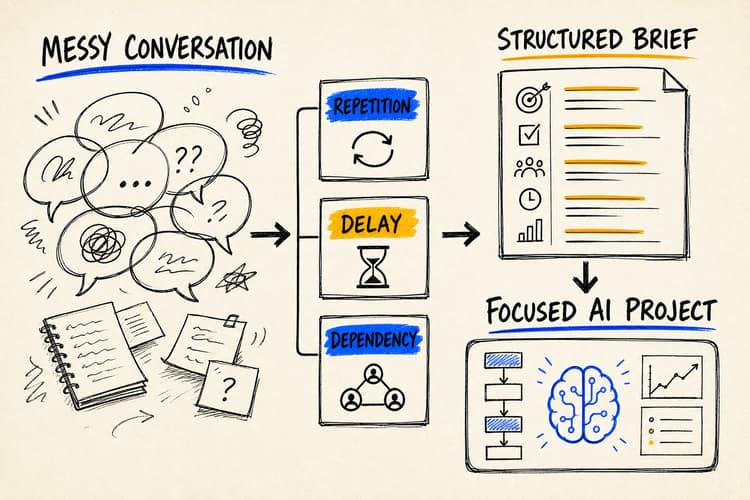
A personal story about leaving a messy discovery call without a clear answer and finding the practical AI project hidden inside it.
Read the field note →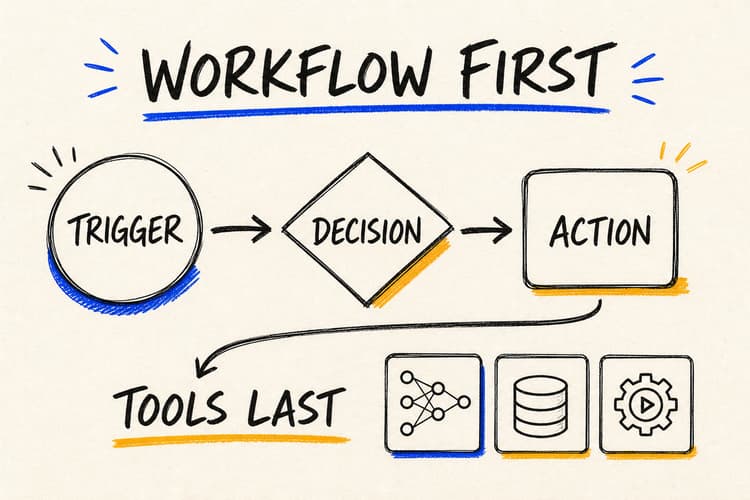
A personal lesson in why AI workflow design should begin with people, decisions and outcomes, not the newest tool.
Read the field note →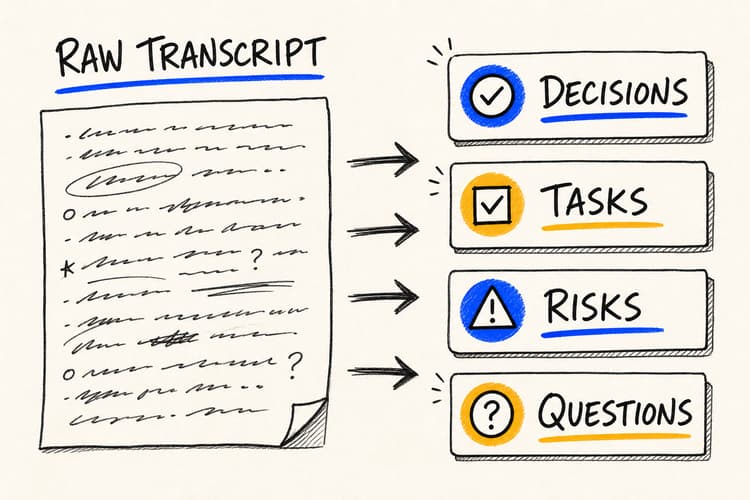
A personal story about discovering that meeting transcripts are raw material for requirements, risks, decisions and better products.
Read the field note →Let’s make the work clearer