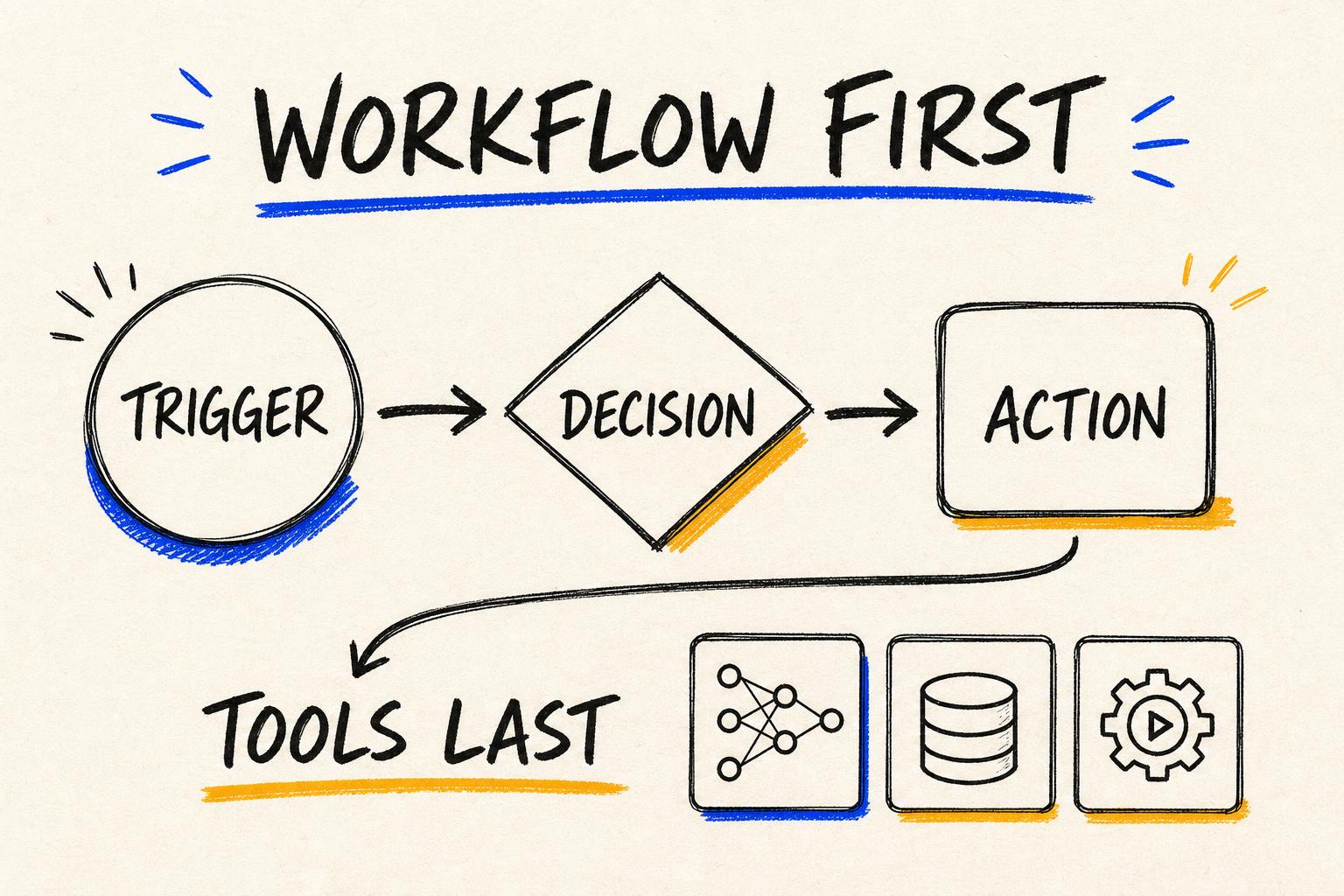
The conversation changed when I closed the tool tabs and drew the workflow on a blank page.
A new model had just been released. I had been testing an automation platform and thinking about agents, retrieval and integrations. So when a business problem came up, my mind immediately began assembling the stack.
It felt productive. I could imagine the architecture before the meeting had ended. But the more I explained, the less certain I became that I understood the actual process. I was solving a technical puzzle the team had not asked me to solve.
That moment taught me a useful kind of humility: knowing more tools does not automatically mean I am seeing the problem more clearly.
I was designing around capability instead of reality.
When I went back to the current process, the real friction was not content generation. It was incomplete inputs, unclear ownership and approvals that happened in different places.
- What starts the process?
- Who owns the next step?
- Which information is required?
- What decision is being made?
- Where does approval happen?
- What happens when something goes wrong?
The proposed AI system had looked sophisticated because I had skipped the messy operational questions. Once I asked them, the architecture became simpler and far more useful.
I separated fixed rules from the moments that needed judgement.
Some work was deterministic: validate a field, create a folder, update a status. Other work needed interpretation: identify risk, summarize context or recommend a next step. Seeing the difference stopped me from forcing AI into every box.