meeting transcript automation7 min read · 03 / 20

The day I stopped treating meeting transcripts like storage.

I kept seeing valuable conversations disappear into folders. The transcript existed, but the decisions, risks and product clues inside it were already fading.

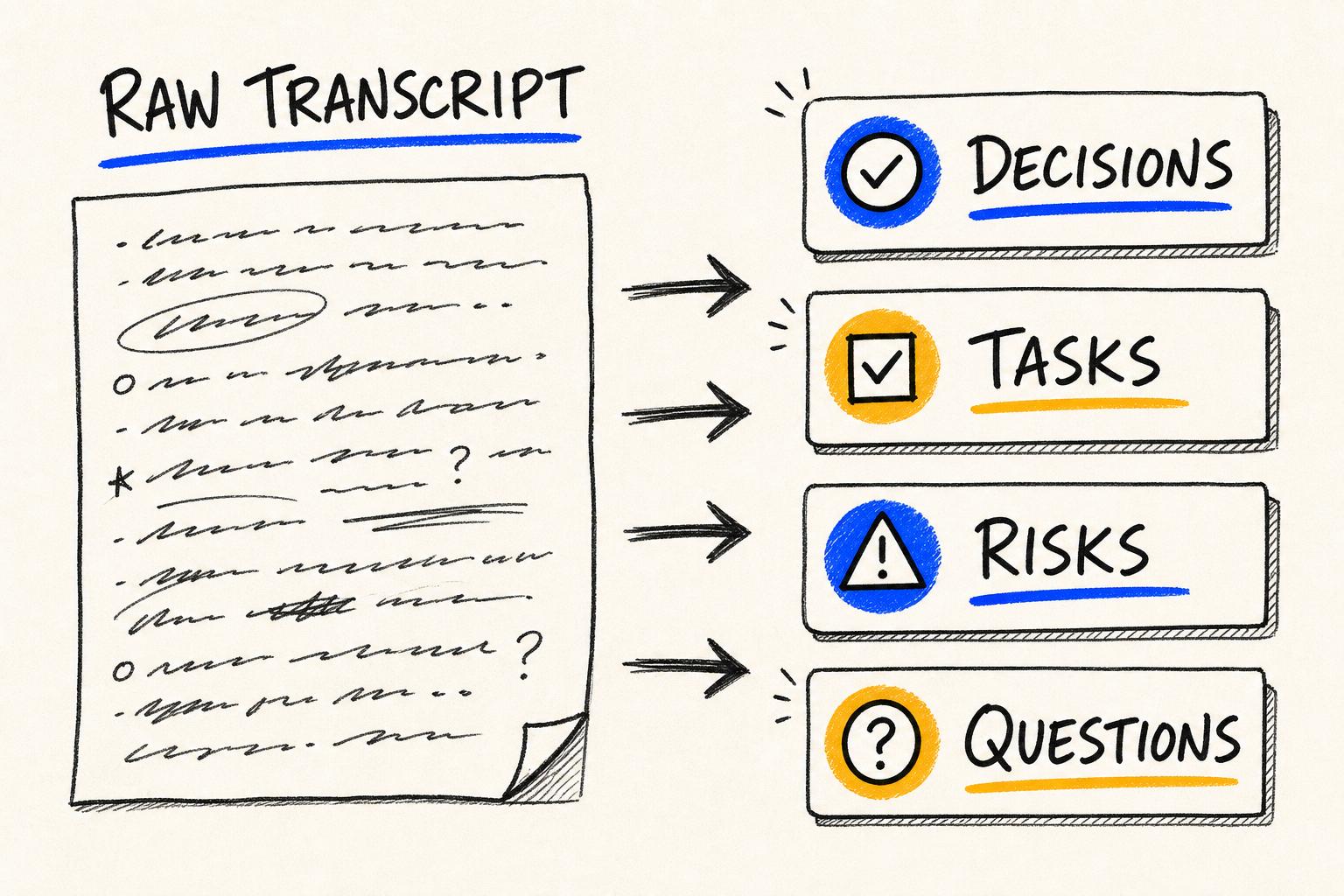
Hand-drawn meeting transcript transformed into structured decisions, requirements, tasks and risks.
A transcript becomes useful when the conversation is transformed into the next layer of work.

The recording was complete. The transcript was searchable. Yet a week later, people still remembered different versions of the decision.

I had assumed transcription solved the meeting problem. We no longer needed to rely on hurried notes, and anyone could return to the exact conversation. Technically, nothing had been lost.

Operationally, almost everything was still at risk. Commitments were buried in paragraphs. Conditions disappeared from summaries. Ideas sounded like approved scope. The transcript had preserved the conversation but not converted it into movement.

That was when I began treating transcripts as raw product material rather than finished documentation.

01 / The missing layer

A summary told me what was discussed, but not what needed to happen next.

The first automated summaries looked impressive. They were clean, readable and broadly accurate. But when I compared them with the transcript, I saw the subtle information that had been compressed away.

  • Confirmed decisions
  • Action items and owners
  • Requirements and constraints
  • Risks and dependencies
  • Open questions
  • Statements needing validation

A sentence such as ‘we can automate this after operations reviews the exceptions’ could easily become ‘automate the process.’ The words were similar. The commitment was completely different.

02 / Preserving meaning

I learned to separate what was decided from what was merely discussed.

The transcript contained facts, suggestions, assumptions, objections, future ideas and rejected options. Once I labeled those categories, the team could review the conversation without accidentally turning every sentence into scope.

The three layers I extract

A meeting gains a second life when meaning, action and learning are separated clearly.

01

Meaning

Preserve the speaker’s conditions, uncertainty and reasoning instead of flattening everything into a summary.

Decisions · objections · assumptions · context
02

Action

Turn commitments into owned tasks, deadlines, follow-ups and unanswered questions.

Owner · due date · dependency · next step
03

Learning

Capture repeated concerns and opportunities that can improve future products and delivery.

Patterns · risks · requests · weak documentation
03 / From conversation to deliverables

One meeting began producing several useful forms of work.

Instead of one generic summary, I began shaping outputs for different needs: a product brief for scope, a task list for execution, a risk register for review and a follow-up document for unresolved questions.

01Product brief02Task list03Decision log04Risk register05Scope draft06Follow-up questions07Source references08Human confirmation

Human review remained essential. The automation prepared a much stronger first version, but a responsible person still confirmed commercial commitments, sensitive requirements and final decisions.

The principle I keptA transcript is not the final output of a meeting. It is the input for everything the meeting should change.
04 / The longer memory

Repeated processing turned isolated calls into organizational knowledge.

Once meetings were structured consistently, patterns became visible across time: recurring client concerns, common implementation risks and the same missing information appearing again and again.

Faster follow-upClearer commitmentsBetter scopeEarlier risk detectionSearchable historyReusable insight

That changed how I saw meeting automation. It was not only a productivity feature. It was a way to build memory that the organization could search, learn from and improve.

What I carry forward

I no longer ask whether a meeting was recorded. I ask what the meeting produced.

Capturing words is useful, but execution depends on preserving meaning and assigning movement. The transcript must become decisions, actions, risks and questions people can review.

When that transformation happens, meetings stop disappearing into storage. They begin contributing directly to product development and better operations.

A conversation becomes an asset when its meaning continues working after everyone leaves the call.