AI cost optimization8 min read · 09 / 20

The AI bill surprised me. The architecture should not have.

I first treated cost as something to monitor after launch. Then one workflow showed me that the expensive decisions had already been made in the design.

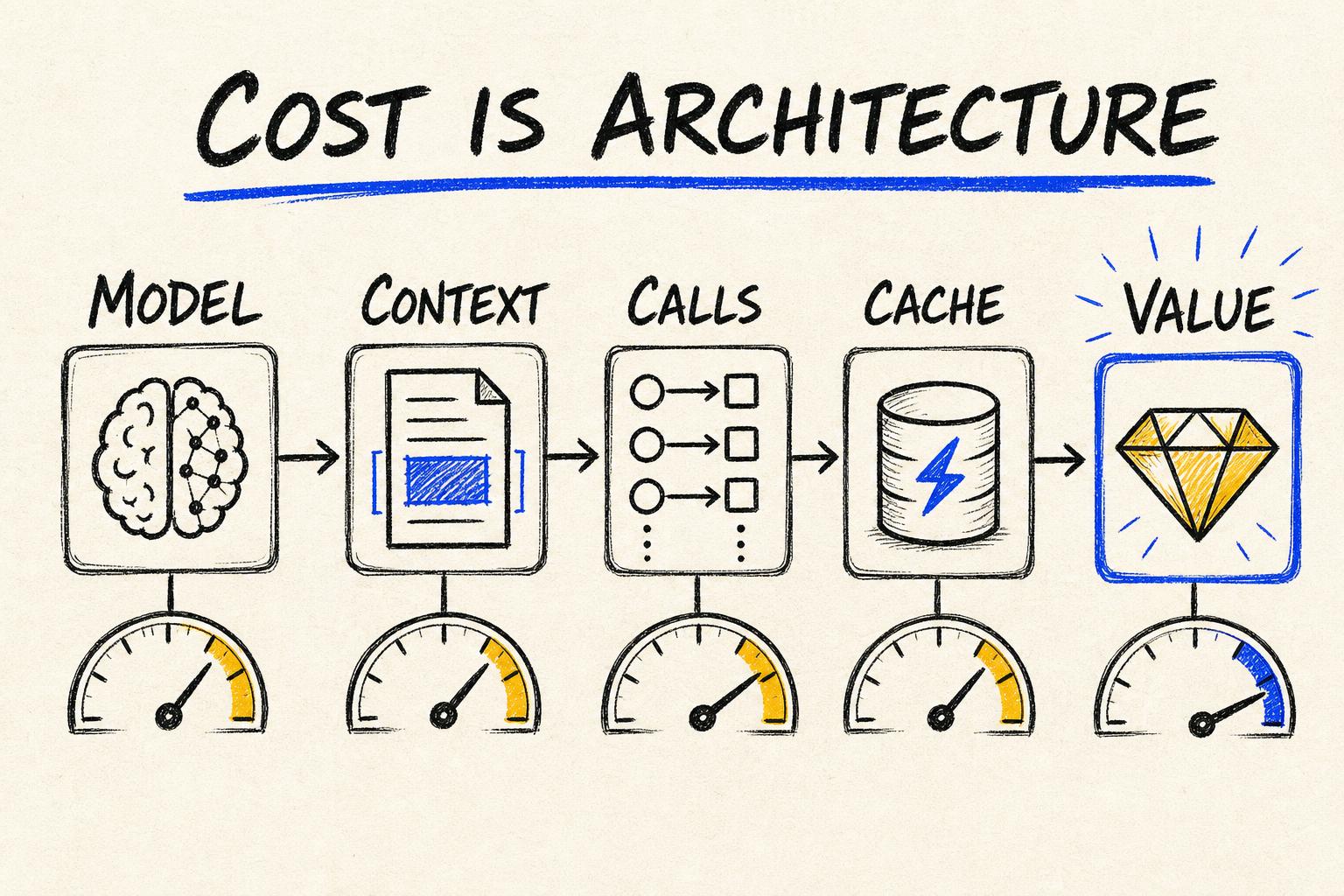
Hand-drawn AI architecture diagram with cost meters attached to model calls, context, storage, retries and review.
Every model call, context choice and retry path carries a cost long before it appears on a finance report.

The invoice did not reveal a finance problem. It revealed a product architecture we had never measured end to end.

One user action triggered classification, extraction, retrieval, generation, review and reformatting. Each call looked inexpensive in isolation. Together, they multiplied cost and latency.

We were also sending more context than the task needed because ‘more information’ felt safer. Retries repeated the same expensive work. Stable documents were processed again and again.

I realized cost optimization had started too late. The architecture was already expressing our assumptions in money.

01 / Counting the whole workflow

A cheap model call did not mean a cheap completed task.

I mapped every call from the user’s request to the final accepted output. That exposed hidden generation, validation and formatting steps that had never appeared in the original cost estimate.

  • Classification
  • Extraction
  • Retrieval
  • Generation
  • Quality review
  • Reformatting

The useful unit was not cost per token. It was cost per successful report, reviewed document or completed workflow.

02 / Matching model to task

The strongest model did not need to perform every kind of work.

Structured extraction and routine classification could use smaller models or deterministic rules. More capable reasoning was reserved for the few steps where it changed quality meaningfully.

The three cost levers

Cost became manageable when we treated it as a design constraint rather than a bill to reduce later.

01

Route

Match model capability to task difficulty and use fixed rules where interpretation is unnecessary.

Rules · small model · strong model
02

Context

Retrieve only relevant, current information instead of sending entire histories and knowledge bases.

Filter · summarize · deduplicate · structure
03

Reuse

Cache stable instructions, summaries and previously processed content with clear invalidation rules.

Cache · expiry · version · refresh
03 / Beyond the model

The full cost included the system and the people around it.

Hosting, databases, vector storage, speech processing, monitoring, third-party APIs and human review all contributed to the real operating cost.

01Cost per completed task02Calls per workflow03Context size04Retry cost05Infrastructure06Third-party APIs07Human review08Value created

Including them made the comparison more honest: what did one completed workflow cost, and what expert time or business risk did it reduce?

The question that mattersWhat does this complete workflow cost compared with the value it creates, not compared with another model call?
04 / Efficient by intention

Lower cost became a side effect of a clearer system.

Removing unnecessary calls improved latency. Better context improved accuracy. Routing protected quality while reducing spend. The same changes made the user experience better.

Fewer callsSmaller contextFaster responseProtected qualityPredictable marginsVisible value

Cost optimization stopped being a late-stage restriction and became a way to test whether the architecture was disciplined.

What I carry forward

I measure cost while the workflow is still a prototype.

Model choice, context, caching, validation and retry behavior are product decisions with financial consequences.

The lowest-cost system is not automatically the best. The intentionally designed system is the one that spends capability where it creates meaningful value.

Efficient AI is not simply cheaper. It is architecture that knows why every expensive step exists.