productize AI services7 min read · 10 / 20

The request I kept solving manually was trying to become a product.

The client names changed. The wording changed. The underlying problem kept returning until I stopped treating each request as a separate piece of work.

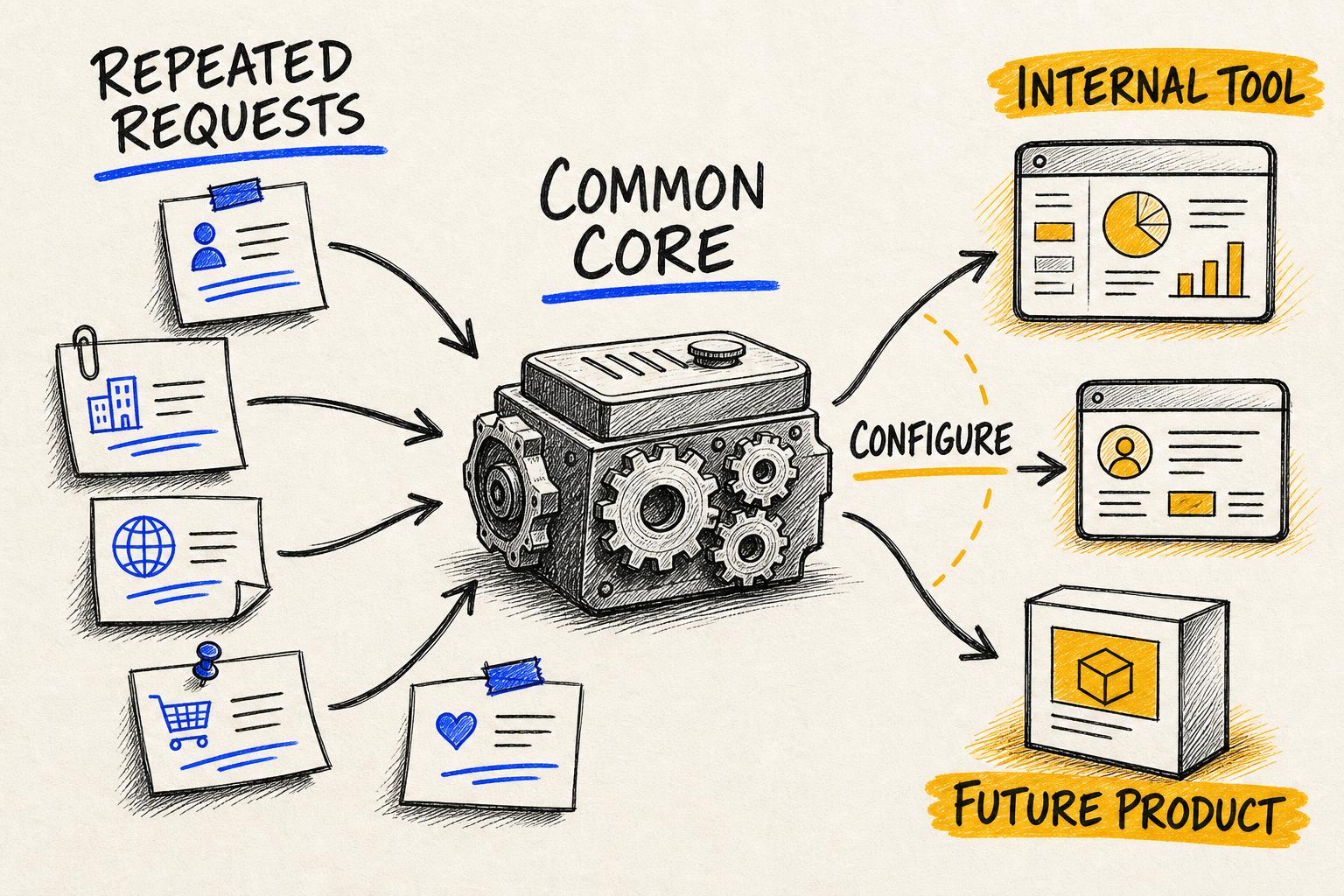
Hand-drawn multiple similar client requests merging into one reusable, configurable AI product.
Repeated service work becomes product research when the common core and the necessary custom layer are made visible.

The third similar request did not feel like coincidence. It felt like the market explaining the product we had not yet named.

One client needed a structured review. Another wanted a report that looked different but required nearly the same analysis. A third described the problem in new language while asking for the same underlying outcome.

We handled each request carefully as bespoke work. That protected quality, but it also meant repeated setup, repeated decisions and repeated opportunities for inconsistency.

I began documenting the pattern instead of only completing the task. Service delivery started showing me a reusable core.

01 / Seeing beneath the wording

Different requests were carrying the same operational need.

The input sources varied, the branding changed and each account had its own rules. But the processing logic, output structure and quality checks were remarkably similar.

  • Common inputs
  • Repeatable analysis
  • Shared output structure
  • Reusable quality checks
  • Account context
  • Necessary exceptions

Once I separated the common work from account-specific context, productization stopped looking like forcing clients into one template.

02 / Internal before external

We built the first version for our own team.

An internal tool gave us a safer place to measure input quality, consistency, time saved, failure patterns and training needs. The team’s corrections shaped the reusable workflow before customers ever saw it.

The productization layers

The pattern became scalable when we protected both consistency and legitimate variation.

01

Core

Standardize what truly repeats: inputs, processing stages, output structure and review rules.

Schema · logic · template · validation
02

Configure

Expose the choices that vary safely without rebuilding the complete workflow.

Brand · source · model · threshold
03

Learn

Use internal adoption and corrections to discover which assumptions are reusable and which are not.

Time · errors · edits · exceptions
03 / Designing for reuse

Configuration replaced hardcoded assumptions.

Output templates, data sources, review rules, permissions, notifications and escalation thresholds became explicit options around the stable core.

01Pattern frequency02Reusable core03Custom layer04Internal pilot05Quality standard06Configuration07Cost model08Expansion trigger

The system could support variation without pretending every account was identical. That balance made the workflow genuinely reusable.

The product signalWhen the same problem keeps returning, the work may be asking to become a system rather than another one-off delivery.
04 / Value before software sales

Product thinking improved delivery even before it became a product.

Outputs became more consistent, onboarding became easier and cost became more predictable. The team depended less on one person remembering every step.

Consistent qualityFaster deliveryEasier onboardingPredictable costReusable learningScalable service

Whether the workflow eventually became client-facing software was secondary. The operational benefit had already justified the shift.

What I carry forward

I treat repeated work as a form of product research.

Every recurring request teaches me what clients value, where the team loses time and which parts of a service can become repeatable without losing care.

The goal is not to eliminate every variation. It is to standardize what is truly common so attention can move to the parts that deserve human judgement.

Service delivery shows me the problem. Product thinking shows me how to solve it repeatedly.