reduce handoffs with AI7 min read · 16 / 20

I was automating tasks while the handoffs kept slowing everything down.

No single step looked especially wasteful. The delay lived in the space between sales, operations, finance, delivery and the systems each team used.

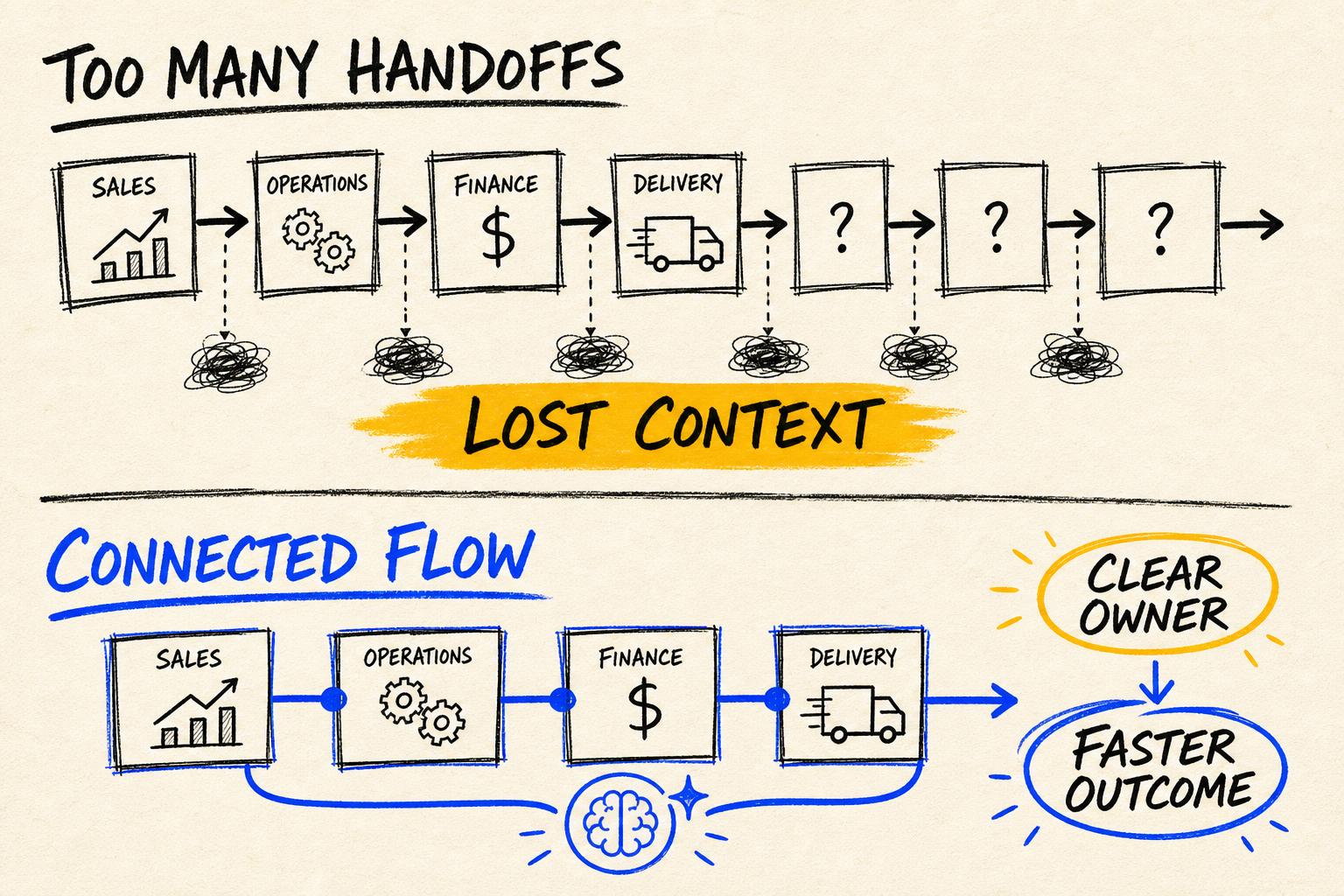
Hand-drawn long chain of business-team handoffs shortened into one connected AI-assisted workflow.
The workflow became faster when context travelled with the work instead of being rebuilt at every handoff.

The inefficiency was not inside one task. It was in every moment someone had to restart the story for the next person.

Sales closed an opportunity. Operations created a project. Finance prepared billing. A manager reviewed notes. Delivery created tasks. Information moved through several tools and people.

Each step made sense. None took very long. But every transition introduced waiting, copying, missing context and a new chance for assumptions to drift.

I had been measuring manual minutes while ignoring the operational distance between people, systems and decisions.

01 / The cost between steps

Handoffs were consuming context as well as time.

The next person received a task but not always the reasoning, constraints or unanswered questions that shaped it. They searched email, asked for clarification and copied information into another template.

  • Waiting for ownership
  • Repeating context
  • Copying between tools
  • Missing constraints
  • Duplicated checks
  • Rework after assumptions

The workflow was moving data without reliably moving understanding.

02 / Connecting the flow

AI prepared the next stage with context already attached.

A status change could create the project structure, extract relevant details, prepare onboarding tasks, flag missing information and notify the right owner. The system reduced transfers without removing responsibility.

The three handoff improvements

A connected workflow moves responsibility, information and reasoning together.

01

Prepare

Give the next owner a ready task with the relevant context, source and open questions already attached.

Brief · source · owner · missing data
02

Preserve

Carry the reasoning behind decisions so the next stage does not reconstruct history from fragments.

Constraint · decision · rationale · approval
03

Connect

Update the systems where work already lives instead of producing another isolated document.

CRM · tasks · docs · notifications
03 / Ownership without transfer burden

Reducing handoffs did not mean making responsibility vague.

Each stage still had an accountable owner. The difference was that ownership arrived with a better-prepared task and visible evidence.

01Trigger02Current owner03Next owner04Context package05Source links06Missing information07Approval state08Completion signal

That improved accountability because the person could see what they owned, why it mattered and what remained incomplete.

The process questionHow many times must a person transfer or reconstruct context before the business outcome is complete?
04 / Measuring the complete journey

We stopped celebrating one fast step inside a slow process.

Total turnaround, handoff count, systems touched, rework and waiting time gave us a more honest picture than minutes saved on one task.

Fewer handoffsLess waitingPreserved contextClear ownershipLower reworkConnected delivery

The strongest improvement came from making the whole journey feel connected, not from maximizing automation in one isolated stage.

What I carry forward

I map the distance between teams before optimizing the speed of one task.

Manual work is visible, but coordination cost often hides in inboxes, copied fields and repeated explanations.

AI creates its deepest operational value when it closes that distance while keeping accountability clear.

The strongest automation does not only make tasks faster. It makes the entire process feel connected.