practical AI tools6 min read · 11 / 20

The AI tool nobody called revolutionary became the one the team depended on.

It did not have a futuristic interface or autonomous agents. It prepared a report, created tasks and saved people from a routine they were tired of repeating.

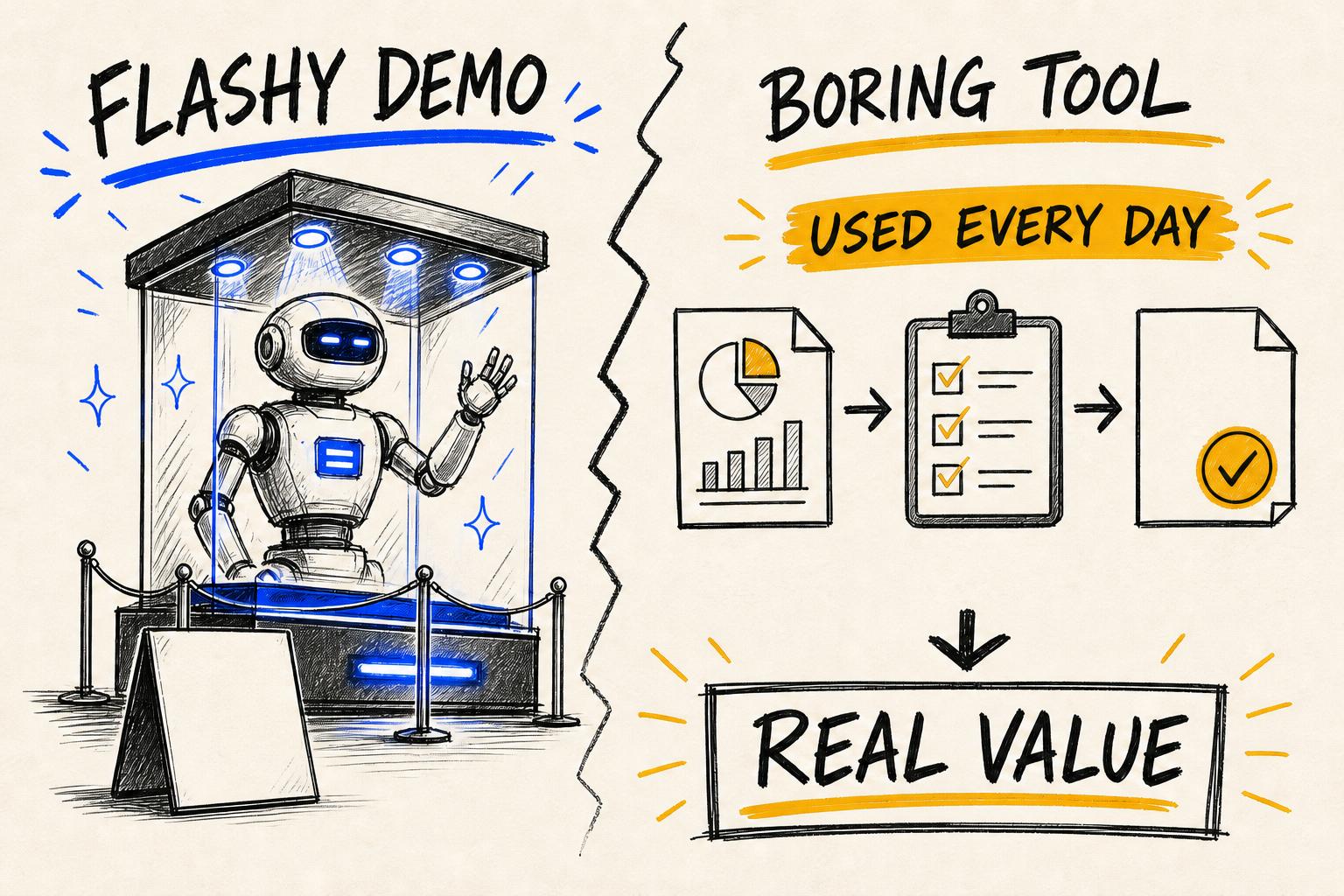
Hand-drawn simple operational AI workflow creating measurable value beside a flashy but unused demonstration.
The quiet workflow kept creating value because it lived inside real work and solved a problem that returned every day.

The demo received more reactions. The ‘boring’ tool received more usage.

One system could reason across several sources and produce an impressive answer on demand. Another converted meeting notes into tasks, checked required fields and prepared a weekly update.

People wanted to see the first one. They kept asking to use the second one. That difference forced me to reconsider how I judged innovation.

Business value often arrives without drama. It appears when a repeated frustration stops consuming attention.

01 / The compounding task

Fifteen minutes did not sound important until it happened everywhere.

A small reporting task repeated across several people and several days. Each execution included searching, copying, formatting and checking. The individual burden looked minor. The organizational burden was not.

  • Weekly reports
  • Task creation
  • Document checks
  • Project briefs
  • Request classification
  • Follow-up drafts

The workflow became valuable because frequency allowed a small improvement to compound.

02 / Adoption over novelty

The tool worked where people already worked.

It appeared inside familiar systems and prepared the next step for review. Users did not need to learn a new AI product or change identity. The assistance arrived inside the workflow they already understood.

Why quiet tools win

A practical AI tool compounds value through frequency, fit and reliability.

01

Frequent

Target work that repeats often enough for small savings to become meaningful over time.

Daily · weekly · every client · every project
02

Familiar

Place assistance inside the tools and steps people already use instead of adding another destination.

Email · tasks · sheet · portal
03

Dependable

Handle incomplete inputs, odd cases and integration failures more carefully than the demo requires.

Validate · retry · review · explain
03 / Reducing steps

The biggest benefit was not only time. It was less mental switching.

The old process moved from transcript to template to task system to email. Each move required someone to carry context and remember what came next.

01Frequency02Steps removed03Systems touched04Acceptance rate05Corrections06Turnaround07Failure path08User pull

Preparing those outputs together reduced handoffs, missed details and the cognitive effort of restarting the same thought in another tool.

The adoption testThe most useful AI tool may be the one people stop describing as AI because it simply becomes how the work gets done.
04 / Measuring the ordinary

Operational metrics told a stronger story than the interface.

We measured time saved, missed tasks, corrections, response time and output acceptance. None of the numbers looked theatrical on their own.

Less repetitionFewer stepsFaster responseConsistent outputLower cognitive loadStrong adoption

Together, they showed a dependable change in daily work, the kind that people notice when it disappears.

What I carry forward

I am less impressed by AI that performs once and more interested in AI that helps every week.

Extraordinary systems will matter, but so will thousands of dependable workflows that remove ordinary friction.

I look for the task people are tired of doing, the handoff they keep repairing and the report they cannot avoid. That is often where useful AI begins.

The best AI tool may not win the demonstration. It may become the tool the team no longer wants to work without.