AI business clarity8 min read · 20 / 20

I thought AI’s biggest advantage was speed. I was looking at the visible part.

Faster drafts and summaries were useful, but the real change came when scattered information became decisions, owners, risks and next actions people could understand.

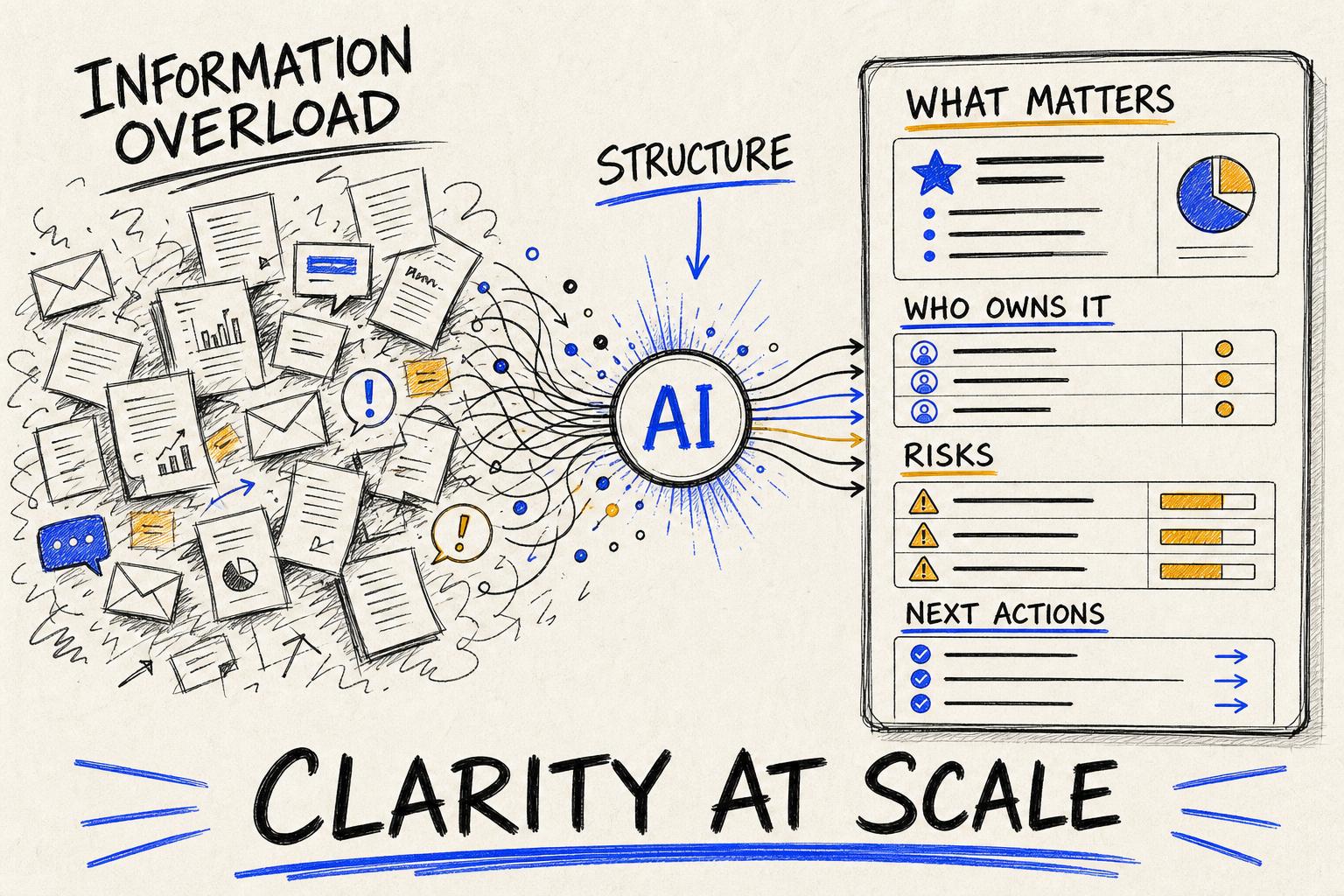
Hand-drawn large volume of scattered business information becoming a clear, grounded decision dashboard through AI.
Speed produces more. Clarity helps an organization understand what matters and act with shared context.

AI was making information move faster. The organization still needed help understanding what the information meant.

Emails, recordings, messages, reports, dashboards, documents, customer feedback and alerts arrived continuously. AI could summarize each source quickly.

Yet teams still asked the same questions: what changed, what matters, what is at risk and who should act? Speed had reduced reading time without necessarily creating shared understanding.

That is when I began seeing clarity at scale, rather than generation alone, as the deeper advantage.

01 / Information is not understanding

The organization did not need another output. It needed structure around meaning.

The most useful workflows converted raw material into decisions, actions, risks, owners, deadlines, dependencies and source references.

  • What changed?
  • What matters now?
  • What is missing?
  • What is at risk?
  • Who owns the next step?
  • Which evidence supports it?

That structure made complexity navigable. People could see what mattered without losing the evidence behind it.

02 / Clarity improves execution

When context became clear, the operating system became calmer.

Teams prioritized better, managers saw risk sooner, meetings became more focused and new employees understood history faster. The improvement reached beyond one task because shared context changed coordination.

The three forms of clarity

AI creates lasting value when it clarifies the present, preserves the past and supports the next decision.

01

Present

Structure current information into the changes, risks, owners and actions that require attention now.

Status · priority · risk · next step
02

Memory

Preserve why decisions were made, what was tried and which patterns repeat across time.

History · rationale · pattern · learning
03

Decision

Bring relevant evidence and uncertainty together so people can choose and explain the next move.

Evidence · options · trade-off · owner
03 / Grounding the clarity

A clear answer without reliable evidence could become confident misinformation.

Approved sources, citations, permission checks, freshness rules and visible uncertainty kept clarity connected to reality.

01Approved sources02Evidence references03Facts vs suggestions04Uncertainty flagged05Permissions respected06Corrections allowed07Freshness visible08Owner identified

The system distinguished facts from suggestions and allowed correction. Understanding became trustworthy because it remained reviewable.

The strategic shiftThe model is available to everyone. The operating discipline that turns information into grounded clarity is not.
04 / The advantage that compounds

Clarity became more valuable as the organization became more complex.

Small teams can rely on direct conversation and shared memory. Growth fragments knowledge across people, systems and time.

Better prioritiesEarlier riskClear ownershipFaster onboardingExplainable decisionsScalable knowledge

AI can reduce that cost by making institutional context searchable and reusable if the organization designs the processes, sources and feedback that keep it trustworthy.

What I carry forward

Working faster is valuable. Understanding faster changes the organization.

AI can convert scattered conversations into requirements, data into decisions and repeated work into reusable systems.

The competitive advantage comes from the operating discipline around those capabilities: how evidence is structured, how decisions are reviewed and how learning returns to the workflow.

The real AI advantage is not speed alone. It is clarity that continues working as the organization grows.