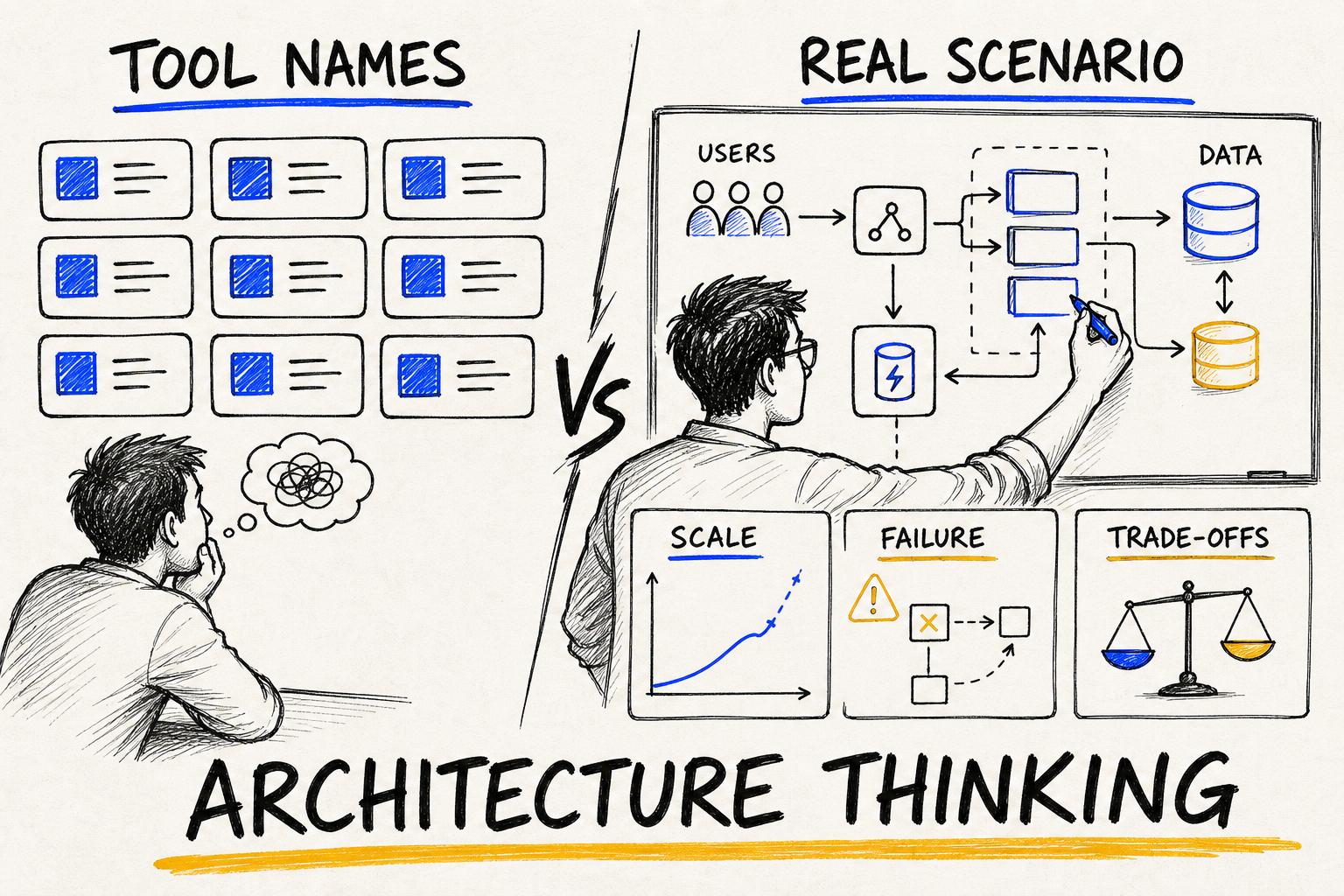
Knowing the tool landscape is useful. Knowing why and where to use a tool is the capability the interview must uncover.
The answer included agents, retrieval, embeddings, fine-tuning and several platforms. Nothing was technically wrong. Yet every choice appeared before the user, decision and operating conditions had been defined.
I realized our questions were rewarding familiarity more than architecture thinking. Asking ‘have you used a vector database?’ made it easy to repeat experience without demonstrating judgement.
The interview became more revealing when we replaced tool questions with a realistic system scenario.
A knowledge assistant with permissions and changing documents created real trade-offs.
The candidate had to consider ingestion, chunking, metadata, retrieval, authorization, freshness, evaluation, cost, monitoring and failure handling.
- Who is the user?
- What decision is supported?
- Which data is permitted?
- How fresh must it be?
- What happens when wrong?
- How is success measured?
The value was not a single correct architecture. It was seeing how they identified risk, asked questions and explained why one approach fit the situation.
Strong candidates explained what their choice protected and what it sacrificed.
Why retrieval instead of fine-tuning? Why asynchronous processing? Why a smaller model for some tasks? Why human approval? The reasoning mattered more than the brand name.