AI data readiness8 min read · 05 / 20

I wanted AI to understand the business. The business information was not ready.

The assistant sounded confident, but it was missing decisions hidden in emails, context trapped in people’s heads and documents nobody knew were outdated.

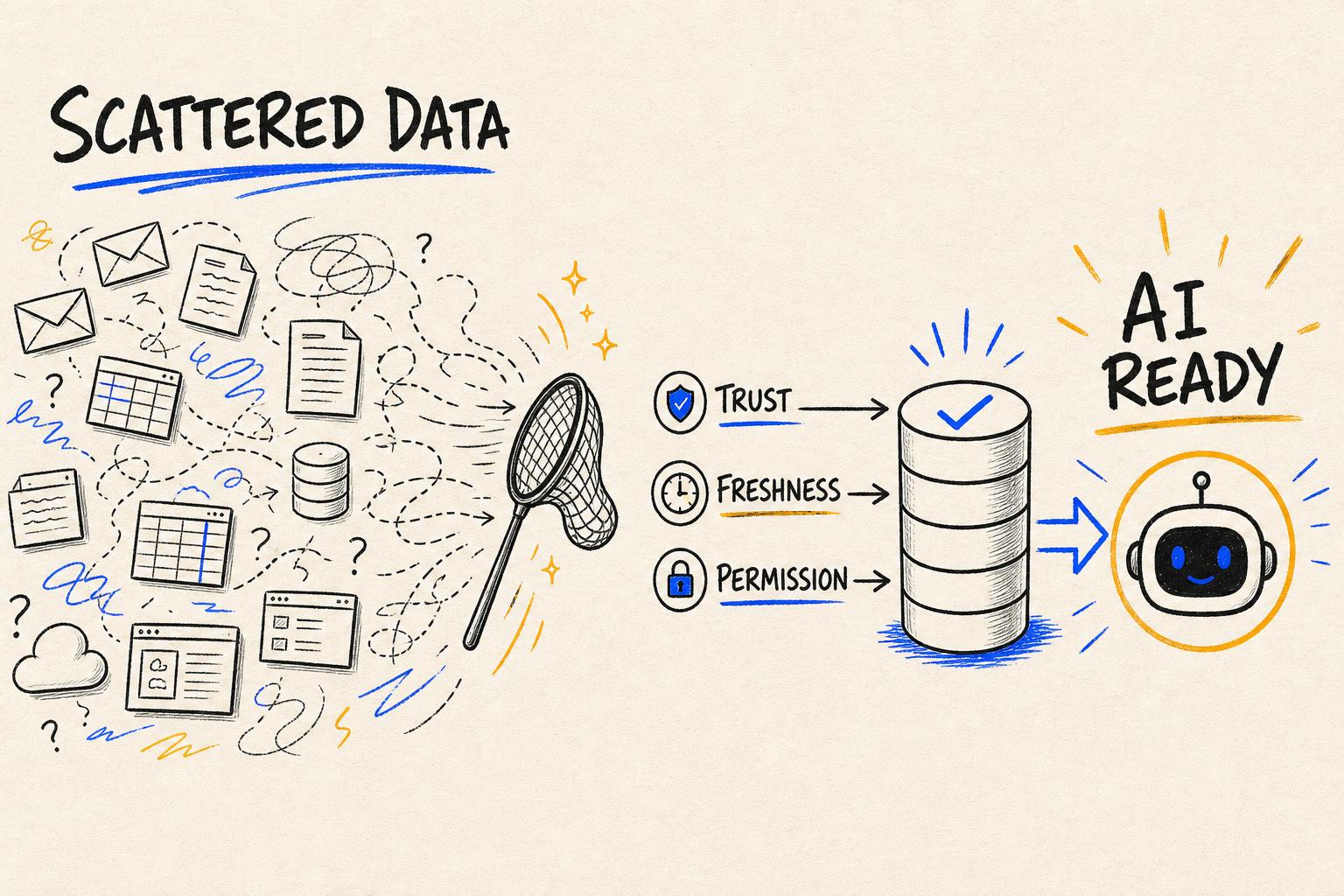
Hand-drawn disconnected documents and business systems organized into a clean, searchable and permission-aware data layer.
A powerful model cannot reason over context the organization has not made available, current and trustworthy.

The first response impressed me. The second made me uneasy. By the third, I realized the model was not the problem.

We wanted an assistant that understood client history, prepared reports and answered operational questions. The model could write fluently and retrieve documents quickly. On the surface, the prototype was working.

Then we asked a question that depended on a recent decision. The answer used an older document because the new decision lived in a meeting and a private message. The system was technically correct about the information it had. The organization had never given it the full truth.

That moment changed the conversation from model selection to data readiness.

01 / The scattered business

The information existed, but not in a form the system could responsibly use.

Important context was spread across email, transcripts, task tools, shared drives, CRM records, spreadsheets and individual memory. Some sources were current. Others contradicted one another.

  • What information exists?
  • Where is it stored?
  • Who owns it?
  • How current is it?
  • Who may access it?
  • How is it corrected?

I stopped asking how to make the model smarter and began asking which information deserved to be trusted, who owned it and how it would stay current.

02 / The useful data layer

We did not need every document. We needed the right approved context.

The breakthrough was narrowing the first domain and creating a practical intelligence layer: current records, decision logs, approved documents, structured tasks and clear source references. Less information became more useful because its meaning and ownership were visible.

The three qualities I now check

Data becomes AI-ready when it is trustworthy, current and permission-aware.

01

Trust

The system must know which sources are approved, complete and reliable enough for the task.

Owner · source · status · validation
02

Freshness

Old decisions need dates, archive rules and review cycles so they do not quietly outrank reality.

Modified · reviewed · active · archived
03

Permission

AI should respect the same access boundaries as the systems and people providing the data.

Role · account · field · audit
03 / Starting with one domain

Organizing everything was impossible. Making one workflow trustworthy was achievable.

We selected one area, defined the records it needed and connected only the sources that could be governed properly. That made testing honest because we knew what the assistant should and should not know.

01Defined domain02Source inventory03Document owners04Approved content05Freshness rules06Permission model07Conflict handling08Review schedule

The narrow foundation also exposed process issues the AI project had not created: missing ownership, duplicated records and decisions that were never documented.

The question that changed the buildBefore asking what the assistant should do, can I prove it has the right information to do it responsibly?
04 / Adoption through trust

People used the system more when they could see where its answer came from.

Source references, dates and clear access rules reduced the fear of a mysterious black box. Users could verify important claims and correct weak information at the source.

Grounded answersClear ownershipCurrent contextSafer accessFaster verificationStronger adoption

That feedback improved both the AI workflow and the organization’s underlying knowledge habits.

What I carry forward

AI adoption is often an organizational readiness project disguised as a model project.

A powerful model cannot repair context it never receives or know that an undated document is no longer true. The architecture must make trust, freshness and access visible.

I now see data preparation not as work that delays AI, but as the work that makes responsible AI possible.

When information becomes structured, current and owned, AI stops guessing about the business and starts helping it.