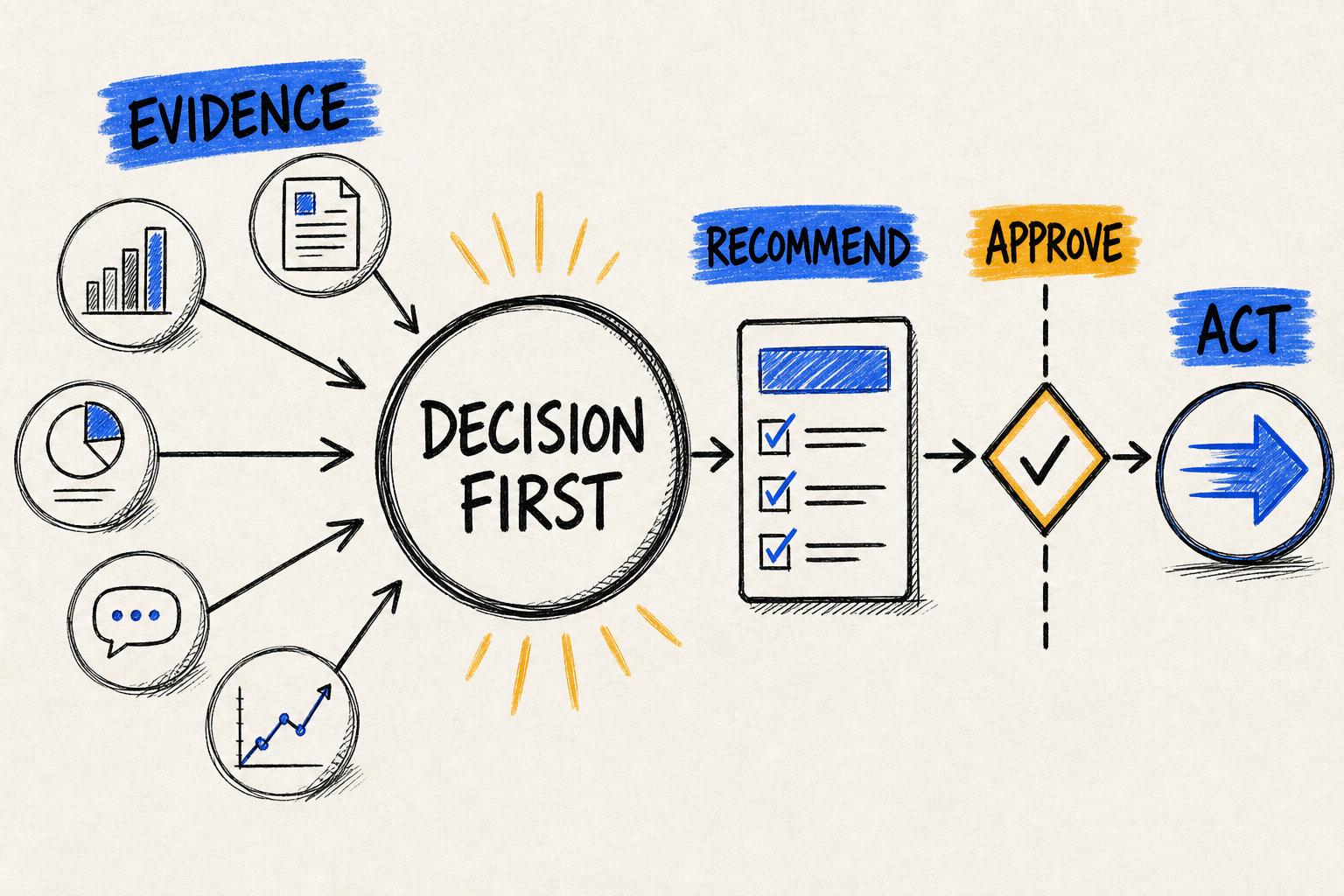
An agent without a decision to support can stay endlessly busy without becoming useful.
The request included a long list: connect systems, understand context, generate recommendations and take action. Each capability was technically possible.
As I tried to shape the product, the scope kept expanding. A general agent needed access to more data, more tools and more permissions, while the expected business outcome remained vague.
The project became clearer when I replaced ‘what should the agent do?’ with ‘what should a person be able to decide better because this agent exists?’
A specific decision gave the agent a responsibility.
Should this lead receive immediate attention? Is the document ready for submission? Which project requires escalation? Each question implied a different evidence set and a different risk boundary.
- Decision owner
- Evidence needed
- Frequency
- Risk level
- Action boundary
- Success measure
The agent stopped being a collection of features and became a focused workflow with a reason to exist.
The quality of the answer depended on the evidence the agent could organize.
For project risk, that meant deadlines, recent activity, blockers, capacity, communication, scope changes and pending approvals. Designing retrieval around the decision was more useful than giving the agent broad access to everything.